Friday, December 21, 2012

American Spending

The Cost of Spending: In search of solutions to America's debt crisis

By Bret Baier | Published December 21, 2012 FoxNews.com

Read more: http://www.foxnews.com/politics/2012/12/21/cost-spending-in-search-solutions-to-america-debt-crisis/#ixzz2FldlmKKC

We're always hearing from politicians about the urgency of the nation's fiscal situation. The debt is over $16 trillion. Deficits -- the annual shortfall -- are persistently north of $1 trillion. 

Those figures are constantly in the background, reminding both parties that whatever the solutions, they need to find and act on them quickly. And the solutions will have to be big -- because the problem is massive.

Tuesday, November 27, 2012

Stocks Bullish for 2013 ?

Why Has Wall Street Gotten So Bullish About Next Year? - CNBC Jeff Cox
Even the bears are bullish for 2013, a year in which virtually every Wall Street expert believes the market will overcome its many headwinds and post a positive year.
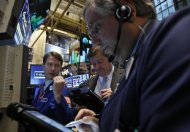
The New York Stock Exchange. REUTERS/Brendan McDermidWhile retail investors have been preoccupied with worries over fiscal armageddon, an election that is now past and a global economy nearing stall speed, strategists have been busy with projections that see sizeable stock gains.
Their reasons: A U.S. economy that is on the mend due to the nascent housing recovery and an expected surge in earnings, more cheap money from the Federal Reserve, and a general feeling that none of the various-worst scenarios out there will come to fruition.

Republicans: Tax hikes alone hardly dents budget & deficit


Republicans say raising tax rates alone will hardly put dent in budget, deficit - FoxNews.com

Republican congressional leaders, in their battle to extend the current low tax rates for all Americans, drive home Tuesday their argument that ending those rates for families earning more than $250,000 a year would produce only enough money to run the government for less than nine days.

The lawmakers pointed out that President Obama's tax rate plan would generate just $82.3 billion annually, as estimated by the non-partisan Congressional Budget Office. Republicans argue he should be focused on a more balanced approach that includes cuts to federal spending -- including to entitlement programs, such as Medicare, Medicaid and Social Security.

Thursday, June 7, 2012

Friday, June 1, 2012

Jobs disappointment raises probability of QE3

US jobs data fuels QE3 fire – Financial Post, Jonathan Ratner

Disappointing U.S. job data is providing further ammunition for supporters of another round of outright quantitative easing, as opposed to extending operation twist.

The U.S. labour market added just 69,000 jobs in May, falling well short of consensus estimates of 150,000. More bad news came as negative revisions to the prior three months took out another 49,000 jobs. The unemployment rate edged up to 8.2% from 8.1%.

“This report is a serious boost to QE3 prospects…” said Derek Holt, economist at Scotiabank. “On both headline and details, the Fed’s full employment half to their dual mandate was sharply disappointed here and both in terms of the current month and backward revisions.”

Related

Monday, May 21, 2012

What is Money

What is Money? A study on Money – Christopher Laird

Money: Any circulating medium of exchange, including coins, paper money, and demand deposits. Dictionary.com

In this piece we discuss what money is, and also money analogs, and make comparisons. We also discuss interest rates as indicators of a healthy economy.

When we discuss money, we discuss what people get for their work. Money is more than a medium of exchange, it is a transferrable unit of work. That is my addition here to that definition. Now, in physics work might be called something a machine does, or what energy can do etc. Gold for instance is directly tied to oil prices because in principle, the work oil energy can do. Hence, oil prices are tied to the king of money – Gold.

I like the definition above mentioning demand deposits. So, a book entry in a bank account such as checking, is a virtual money. These days it’s electronic. Do you remember the days when you had a savings account, and when you made a deposit at the bank, they made an entry into your passbook? So the bank had a record and you also had one, only it was on paper. Interesting no? Of course these days, that kind of method is considered archaic. Electronic money is king now, or is it? Isn’t it?

Saturday, April 28, 2012

Stiglitz: Europe’s austerity is suicide

Europe headed towards ‘suicide’ on austerity: Stiglitz – BusinessTimes

NOBEL Prize-winning economist Joseph Stiglitz said Europe is in a "dire" situation as a focus on austerity pushes the continent towards "suicide".

"There has never been any successful austerity programme in any large country," Mr Stiglitz, 69, told reporters in Vienna on Thursday. "The European approach definitely is the least promising. I think Europe is headed to a suicide."

Politicians across the 27 European Union members are implementing austerity measures totalling about 450 billion euros (S$738 billion) amid a sovereign-debt crisis. At the same time the debt of the euro region rose last year to the highest since the start of the single currency as governments increased borrowing to plug budget deficits and fund bailouts of fellow nations crippled by the fiscal crisis.

Tuesday, April 17, 2012

Best city to live cheaply

The best place to retire overseas on a budget – USNews, Kathleen Peddicord

If an affordable cost of living is your priority in choosing where to retire, take a look at Cuenca, Ecuador. This city is one of the world's best places to retire overseas on a budget.

Cuenca is a beautiful colonial city in an interesting and diverse country. The health care is high quality, honest, and inexpensive. The climate is spring-like and pleasant 12 months of the year. And Cuenca's large and growing expat community is one of Latin America's most diverse and well-blended.

Wealthy cannot escape anymore

Why the party is ending for the rich – USNews, Rick Newman

It has been a great decade to be rich.

Since 2001, high earners have enjoyed the best of all worlds. Tax rates at the top of the income ladder have drifted down to the lowest levels since World War II. Incomes have stagnated for the middle class, but they've continued to rise for the wealthy. And recent policies meant to combat the recession and the 2008 financial crisis have benefited the wealthy more than others.

[See a collection of political cartoons on the economy.]

In the stock market, a "correction" usually sets in when stock values get ahead of underlying fundamentals. Something similar is about to happen to the wealthy.

Thursday, April 12, 2012

European economic crisis – the scale

27 statistics about the European economic crisis that are almost too crazy to believe – Economic Collapse Blog

The economic crisis in Europe continues to get worse and eventually it is going to unravel into a complete economic nightmare.  All over Europe, national governments have piled up debts that are completely unsustainable.  But whenever they start significantly cutting government spending it results in an economic slowdown.  So politicians in Europe are really caught between a rock and a hard place.  They can’t keep racking up these unsustainable debts, but if they continue to cut government spending it is going to push their economies into deep recession and their populations will riot.  Greece is a perfect example of this.  Greece has been going down the austerity road for several years now and they are experiencing a full-blown economic depression, riots have become a way of life in that country and their national budget is still not anywhere close to balanced.  Americans should pay close attention to what is going on in Europe, because this is what it looks like when a debt party ends.  Most of the nations in the eurozone have just started implementing austerity, and yet unemployment in the eurozone is already the highest it has been since the euro was introduced.  It has risen for 10 months in a row and is now up to 10.8 percent.  Sadly, it is going to go even higher.  As economies across Europe slide into recession, that is going to put even more pressure on the European financial system.  Most Americans do not realize this, but the European banking system is absolutely enormous.  It is nearly four times the size that the U.S. banking system is.  When the European banking system crashes (and it will) it is going to reverberate around the globe.  The epicenter of the next great financial crisis is going to be in Europe, and it is getting closer with each passing day.

Wednesday, April 11, 2012

US Tax mayhem

24 outrageous facts about taxes in the US that will blow your mind – Economic Collapse Blog

The U.S. tax code is a complete and utter abomination and it needs to be thrown out entirely.  Nobody in their right mind would ever read the whole thing - it is over 3 million words long.  Each year, Americans spend billions of hours and hundreds of billions of dollars trying to comply with federal tax requirements.  Sadly, it is the honest, hard working Americans in the middle class that always get hit the hardest.  The tax code is absolutely riddled with loopholes that big corporations and the ultra-wealthy use to minimize their tax burdens as much as possible.  Many poor people do not pay any income taxes at all.  The dishonest are rewarded for cheating on their taxes (if they can get away with it) and the ultra-wealthy have moved trillions of dollars to offshore tax havens where they can avoid U.S. taxation altogether.  Our system is incredibly unfair to the millions of hard working people in the middle class and upper middle class that drag themselves out of bed and go to work each day and try to do the right thing.  In addition, the current U.S. tax system is incredibly inefficient, it diverts a tremendous amount of resources away from more valuable economic activities, and it has chased thousands of businesses and trillions of dollars out of the United States.  The U.S. tax code is such a complete and utter mess at this point that it can never be "fixed".  The only rational thing to do is to abolish it completely, and any politician that tells you otherwise is lying to you.

Best cities for trendy people

America’s best cities for hipsters – Travel&Leisure, Katrina Brown Hunt

  1. Seattle, WA
  2. Portland, OR
  3. San Francisco, CA
  4. New Orleans, LO
  5. Portland, MA
  6. Providence, RI
  7. Austin, TX
  8. San Juan, PR
  9. Philadelphia, PA
  10. Denver, CO

Friday, April 6, 2012

Fastest Growing US Cities

Fastest Growing US Cities – CNNMoney

#   Population Growth 2000-2010
1 Charlotte, NC 1,249,449 64.6%
2 Raleigh, NC 884,891 63.4%
3 Cape Coral, FL 530,920 60.8%
4 Provo, UT 482,819 59%
5 Austin, TX 1,362,416 51.1%
6 Las Vegas, NV 1,886,001 43.5%
7 McAllen, TX 728,825 39.3%
8 Knoxville, TN 558,696 33.1%
9 Greenville, SC 400,492 32.5%
10 San Antonio, TX 1,758,210 32.4%

Saturday, March 31, 2012

Geopolitics driving markets

Time to watch the geopolitics once again – Dominick Chirihella
Last week was the third week in a row that oil prices declined. As I have discussed on numerous occasions the main price drivers have been geopolitics, fundamentals and the state of the global economic recovery. None of the three price catalysts have been overly bullish over the last few weeks including the number one price mover...the evolving geopolitics around Iran.
Over the last few days the rhetoric has inched up a notch as the April 13th/14th meeting between Iran and the West scheduled for Istanbul moves closer. President Obama tightened up the economic sanctions on Iran's Central Bank in a hope to motivate them to come to the negotiating table with a more open minded view than they had during previous face to face negotiations. Secretary of State Clinton is in the region over the weekend for other meetings and has mentioned to the media that the US is only interested in a strategy of prevention and not a containment policy for Iran. She also went on to say it soon will be clear whether Iran's leaders are prepared to have a serious, credible discussion about their nuclear program. It is up to Iran's leaders to make the right choice. She further warned Iran (via the press) that the window for diplomacy is closing quickly.
I would say that the market is likely approaching a floor (at least temporarily) in oil prices as the 30 second news snippets floating around the media airwaves over the next several weeks are likely to increase the fear and uncertainty level of most market participants. I also believe that the meetings will not result in a black and white peaceful solution with only minimal progress being made. The market may interpret that type of an outcome as one that could result in the Israeli's becoming more impatient and thus increasing the likelihood of some sort of military strike.

Thursday, March 29, 2012

China headed for recession?

7 signs China’s headed for a recession – Wall Street Daily, Louise Basenese

Much debate has already transpired over whether or not China – the world’s fastest-growing economy – is headed for a recession.

The most zealous China bulls consider such a possibility sacrilegious. Meanwhile, savvy hedge fund managers – with impressive track records, like Jim Chanos of Kynikos Associates – consider it a certainty.

So how’s an ordinary investor supposed to make any sense of such diametrically opposed viewpoints?

It’s simply, really. Stick to the facts. Specifically, the latest data points coming out of China. And then ask this question: Is this the picture of a country in tip-top economic shape?

Here’s a breakdown of the evidence…

Wednesday, March 28, 2012

What drives Oil Prices

Infographic: The Facts behind Oil Prices
Infographic – The Facts behind Oil Prices  (click picture for larger view - opens in new window)

Bonds safe or about to plunge?

This “safe” Asset could plummet 18% (or more) over the next two months – Wall Street Daily, Louise Baseness
By now you’d expect that every investor is preparing for a selloff in long-term bonds. After all, the Fed can’t keep interest rates near 0% forever.
Unfortunately, though, such expectations don’t entirely match reality.
Based on the latest fund flow data from Lipper Research, many investors remain enamored with long-term bonds.
In February, they plowed another $30.9 billion into bond funds, the largest monthly inflow since August 2010. And of that amount, $15.8 billion (or about 50%) went into long-term bond funds.
But not every investor is clueless.

Monday, March 26, 2012

Dollar as reserve currency – will it last?

10 reasons why the reign of the Dollar as the world reserve currency is about to come to an end – EconomicCollapseBlog

The U.S. dollar has probably been the closest thing to a true global currency that the world has ever seen.  For decades, the use of the U.S. dollar has been absolutely dominant in international trade.  This has had tremendous benefits for the U.S. financial system and for U.S. consumers, and it has given the U.S. government tremendous power and influence around the globe.  Today, more than 60 percent of all foreign currency reserves in the world are in U.S. dollars.  But there are big changes on the horizon.  The mainstream media in the United States has been strangely silent about this, but some of the biggest economies on earth have been making agreements with each other to move away from using the U.S. dollar in international trade.  There are also some oil producing nations which have begun selling oil in currencies other than the U.S. dollar, which is a major threat to the petrodollar system which has been in place for nearly four decades.  And big international institutions such as the UN and the IMF have even been issuing official reports about the need to move away form the U.S. dollar and toward a new global reserve currency.  So the reign of the U.S. dollar as the world reserve currency is definitely being threatened, and the coming shift in international trade is going to have massive implications for the U.S. economy.

A lot of this is being fueled by China.  China has the second largest economy on the face of the earth, and the size of the Chinese economy is projected to pass the size of the U.S. economy by 2016.  In fact, one economist is even projecting that the Chinese economy will be three times larger than the U.S. economy by the year 2040.

So China is sitting there and wondering why the U.S. dollar should continue to be so preeminent if the Chinese economy is about to become the number one economy on the planet.

Over the past few years, China and other emerging powers such as Russia have been been quietly making agreements to move away from the U.S. dollar in international trade.  The supremacy of the U.S. dollar is not nearly as solid as most Americans believe that it is.

As the U.S. economy continues to fade, it is going to be really hard to argue that the U.S. dollar should continue to function as the primary reserve currency of the world.  Things are rapidly changing, and most Americans have no idea where these trends are taking us.

Thursday, March 22, 2012

Nicest Cities in the world

10 Nicest Places to Live
  1. Vienna, Austria
  2. Zurich, Switzerland
  3. Auckland, New Zealand
  4. Munich, Germany
  5. Dusseldorf, Germany
  6. Vancouver, Canada
  7. Frankfurt, Germany
  8. Geneva, Switzerland
  9. Copenhagen, Denmark
  10. Bern, Switzerland